Fear of technology making your job obsolete: what the data says and what to do
- In an August 2026 Gallup survey, 27% of U.S. workers said they are worried that technology will make their job obsolete. It is the highest figure in the series: seven points more than in 2025 and double that of 2017.
- For Latin America, the IDB estimates that wages could rise between 2.3% and 5.3% if people manage to move into growing areas, or fall between 13.5% and 20.9% if they cannot. These are scenarios, not forecasts.
- What happens depends as much on the ability to move and train talent as on the technology itself.
- Below you will find three questions to learn what your team thinks, instead of assuming it.
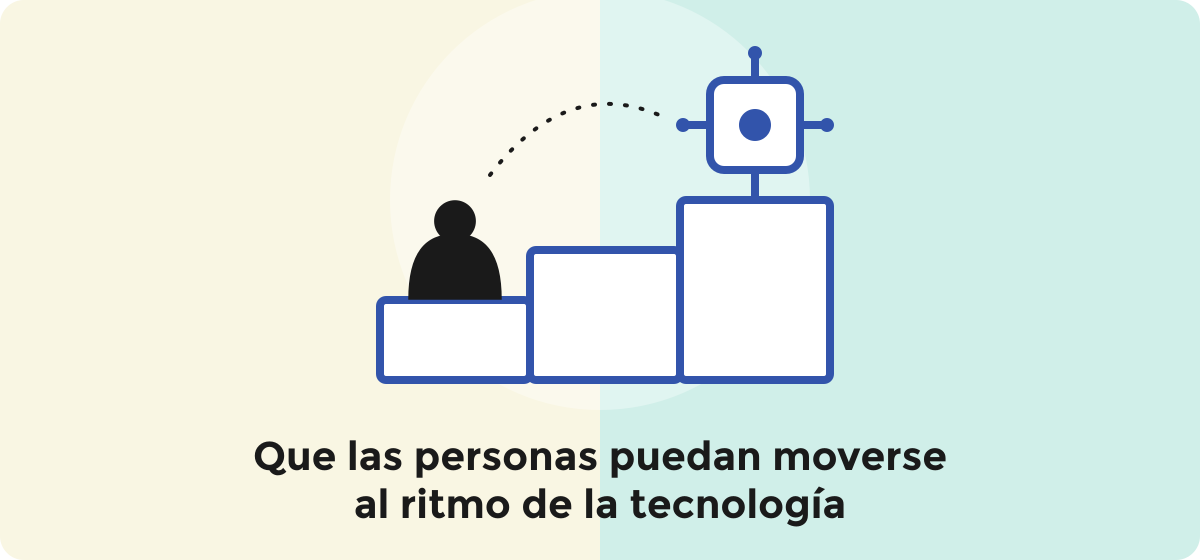
We talk a lot about what artificial intelligence can do and less about how the people working with it feel. This guide brings together three recent news items that, read together, tell the same story: technology is already here, and what defines how each person and each company fares is what happens around it.
How many workers fear technology will make their job obsolete
Gallup asked 1,200 U.S. adults in its Work and Education survey (August 3 to 24, 2026, phone interviews; 507 of them were employed, with a margin of error of ±6 points). It published the results on September 15, 2026.
- 27% of workers fear technology will make their job obsolete.
- It is the highest figure since the question was first asked. It was previously 13% (2017), 15% (2018), 17% (2019), 15% (2021), 22% (2023) and 20% (2025). Gallup did not ask the question in 2020, 2022 or 2024.
- It worries those under 45 more: 34%, versus 19% among those over 45.
- It grew both among those with a college degree (25%) and those without one (29%).
- The traditional fears barely changed: that benefits will be reduced (33%), that they will be laid off (24%), that hours will be cut (21%) or that pay will go down (21%).
To read it calmly: it is a U.S. survey, it speaks of "technology" and not only artificial intelligence, and the worker sample is 507 people. It is not a measurement of Colombia, but it is a useful signal: the fear of being left behind already weighs more than several classic work fears. Read it at Gallup.
What could happen to wages in Latin America
On September 21, 2026, the IDB Group brought together heads of state and technology leaders, alongside the UN General Assembly, to discuss AI. In its press release it previewed figures from a report to be published in November 2026 (From Digitalization to Artificial Intelligence: Turning Promises into Productivity):
- Broad AI adoption with large productivity effects could raise the GDP of Latin America and the Caribbean by 5.1% in a decade. With limited adoption, only 0.3%.
- On wages, the outcome forks: they could rise between 2.3% and 5.3% if workers manage to move into expanding areas, or fall between 13.5% and 20.9% if they cannot.
The reading that interests us most is this: the result depends on something that is not technological, the ability to prepare and move talent to where value is created.
To read it calmly: these are scenarios ("could"), calculated by the IDB itself, and the full report has not yet been published, so the figures cannot be checked yet. Read the IDB press release.
What a company can do
This is what we propose at Método y Estrategia, based on what we see in the field. These are our own criteria, not recommendations from the studies cited.
1. Ask before assuming
Often what the team feels about technology is assumed. A short conversation, with three questions, already gives valuable information:
- Which part of your work do you think technology could change in the next two years?
- What would you like to learn to feel at ease with that change?
- What do you need from the company to be able to do it?
2. Build commitment instead of demanding it
Tatiana Agudelo, from the Método y Estrategia team, tells how, when someone on a team came back to work after a medical leave, the first question was not about the certificate but "do you feel well enough to work from today?", and the answer could be no. Her idea: commitment cannot be demanded permanently, it is built. When people do not have to prove their worth all the time, they end up giving much more than is asked of them. Read it on LinkedIn (in Spanish).
3. Look at the whole job, not just the task
Jose Cardona, co-founder of Método y Estrategia, tells how he was sought out to develop software and the project ended up requiring much more than code: understanding requirements, designing an architecture, learning new services on the fly and, above all, knowing how to communicate. Because, in his words, "a misunderstood requirement costs more than any bug". When technology absorbs a task, the skills that gain weight are usually the ones surrounding that task. Read it on LinkedIn (in Spanish).
Two tool examples that show how much the "after" matters
AI interviews already available. Amazon Connect Talent, from AWS, became generally available on September 16, 2026, for now in two U.S. regions (Virginia and Oregon). Its AI agents run structured voice interviews at any hour and score candidates; recruiters receive scores, transcripts and evaluations. The question that remains open: which part of getting to know a person can be structured without losing exactly what is being sought? AWS announcement.
An AI agent in production needs someone to review it. On September 22, 2026, AWS introduced Amazon CloudWatch Omni, a tool to observe AI agents: it records every step an agent takes and comes with 17 built-in evaluators that score its answers on things like coherence or helpfulness. It is technical, but the underlying idea is not: automation does not end the day the agent starts working; someone has to be responsible for making sure it keeps doing it well. AWS announcement.
Get ideas like this every three weeks
We only need your name and email. No spam: one edition every three weeks, and you can unsubscribe whenever you want.
Frequently asked questions
How many workers fear technology will make their job obsolete?
According to Gallup (August 2026), 27% of U.S. workers, the highest figure since 2017, when it was 13%. It is U.S. data and about "technology" in general, not only artificial intelligence.
Which group worries most about becoming obsolete?
Those under 45: 34% versus 19% of those over 45, according to the same Gallup survey. The concern grew both among those with a college degree (25%) and those without one (29%).
What could happen to wages in Latin America because of AI?
The IDB projects scenarios: wages could rise between 2.3% and 5.3% if workers can move into expanding areas, or fall between 13.5% and 20.9% if they cannot. These are the IDB's own estimates from a report to be published in November 2026.
How can I find out what my team thinks about technology?
By asking. A short conversation with three questions, about which part of their work could change, what they want to learn and what they need from the company, gives more information than any assumption.
What is AI agent observability?
It is being able to see what an AI agent does step by step and evaluate whether its answers are correct and coherent. Tools like Amazon CloudWatch Omni make it possible; the idea is that someone remains responsible for watching the agent after putting it to work.
Sources
- Gallup, Saad, L. More U.S. Workers Fear Losing Their Jobs to Technology. September 15, 2026.
- IDB Group. IDB Group Convenes Heads of State and Technology Leaders to Advance AI Agenda. September 21, 2026.
- AWS. Amazon Connect Talent, general availability. September 16, 2026.
- AWS. Introducing Amazon CloudWatch Omni. September 22, 2026.
- Agudelo, T. Post on commitment and Cardona, J. post on his software project, on LinkedIn (in Spanish).
The data corresponds to the date of the edition (September 24, 2026).
Prefer to do it with support?
Our starting point is a diagnosis that looks at strategy, talent and technology together. Let's talk about your company.
Let's talk