Why technology investments fail (and how to avoid it in your company)
- In an Eagle Hill survey of 200 senior executives in the U.S., 51% said recent technology investments did not deliver the intended results; the most mentioned reason was having underestimated how day-to-day work would change.
- Saving time is not the same as creating value: value comes from what we do with that time.
- A three-step exercise (choose one task, talk through three things and measure speed and quality together) helps improve a task without losing quality, with or without AI.
Has this happened to you: you buy a tool that promised to change everything and, months later, your team is still working almost the same way? It is a very common problem, and often it is not the technology's fault: something earlier failed. Nobody chose well which task to improve, or nobody supported the people who were going to use it.
In this guide we tell you what recent studies say, what we learned from reading AWS's Reimagine report, and a three-step exercise you can do with your team, with or without artificial intelligence.
What the recent data says
Two studies from this year point in the same direction:
- Eagle Hill Consulting (with fieldwork by Ipsos) asked 200 senior executives at U.S. companies with revenues of USD 100 million or more in March. 51% say recent technology investments did not deliver the intended results. What they mention most is having underestimated how day-to-day work would change: only 35% say they took it into account before implementing, and about a third still use the old processes or alternative shortcuts.
- edX Enterprise and NewtonX surveyed 507 learning and talent leaders at companies with 500 or more employees, worldwide, between June and July. They asked about AI capabilities, but what they report applies to any technology: 83% say preparing their people is an active priority, but only 29% feel they already have mature capabilities, and 78% do not have a solid mandate to lead it.
A couple of clarifications so you can read them calmly. Neither is a study about Colombia. Eagle Hill is a consultancy that sells change management, and edX is a corporate training provider. That is why we take them as signals, not as a neutral measurement. What we do find useful is what they say together: the difficulty usually lies in the work and in the people, not in the tool.
Saving time is not the same as creating value
Between 2025 and 2026, the AWS executives-in-residence team conducted 154 interviews with executives to understand what separates those who get value from artificial intelligence from those who do not. The result is the Reimagine report. One of its central ideas seems useful to us for any company, whether it uses AI or not, because it separates three things we tend to mix up:
- Efficiency: doing a task faster or at a lower cost.
- Productivity: getting more results with the same resources.
- Value: achieving results that matter to customers and to the business.
The report gives a clear example: a team that generates code 30% faster but waits three weeks for an approval process is more efficient without being more productive. The bottleneck simply moved somewhere else. And what struck us most is that almost nobody could say what they had done with the time the technology freed up.
One of the interviewees, Rashed Iqbal, chief technology officer at RAK IDO, sums it up well: "If I can do in one hour a job that takes four, but there is no structure to use the three hours I saved, there is no benefit for the company" (our translation).
Some leaders solved it with a simple rule: every efficiency improvement had to come with a named initiative that would use that time in the same quarter. Another executive, from WHOOP, said he made it clear, publicly and repeatedly, that the time saved would translate into investment and not into job cuts, something that helps people feel encouraged to try new things.
A warning: this is qualitative research, carried out by AWS, and the authors themselves state that their findings cannot be generalized. We use them as ideas to try, not as universal truths.
Practical guide: three steps to improve a task without losing quality
This is the idea we propose in our newsletter. It works with one task at a time, and you can do it with your team in one or two conversations.
Step 1: choose a task that eats up many hours today
Look for a task that repeats and consumes the team's time: putting together the monthly report, cross-checking information between files, answering the same questions over and over. Before deciding how to improve it, do the exercise the report describes: follow a single real request from start to finish, for example an order, a complaint or a hire, and write down every handoff, every wait and every rework.
According to the report, teams that do this tend to discover that the step they were going to automate was rarely the real bottleneck. It is an inexpensive exercise and it can save you from buying a solution for the wrong problem.
Step 2: talk through three things
Together, answer:
- Who is accountable for this task, by name? Not a department or a committee: one person.
- If we manage to save time, what will we use it for? Better if it is something concrete: serving more customers, reviewing more carefully, doing something we currently cannot get to.
- How will we know it truly improved?
Step 3: measure two things together
Measuring only the hours saved is misleading, because it measures activity and not results. The report recommends pairing every speed measure with a quality measure. Here are some example pairs (the first is our adaptation; the other three come from the report):
- Hours saved and errors or rework.
- Cycle time and error rate.
- Closing time and correction requests.
- Cases resolved per day and customer satisfaction.
If the hours go down but the errors go up, the savings are only apparent. The report suggests looking at both measures for about three months before deciding whether the original measure was telling you the truth.
Where does artificial intelligence come in?
If the task has a repetitive part, today AI can help with things like summarizing information, cross-checking data from several files, drafting documents or detecting anomalies. Some ideas to get more out of it:
- Give it context. The report describes that those who get the best results do not ask "summarize this": they state the role, the data, the format they expect and the constraints. And they treat the first answer as a draft to be refined.
- Start small and review the result together before expanding it.
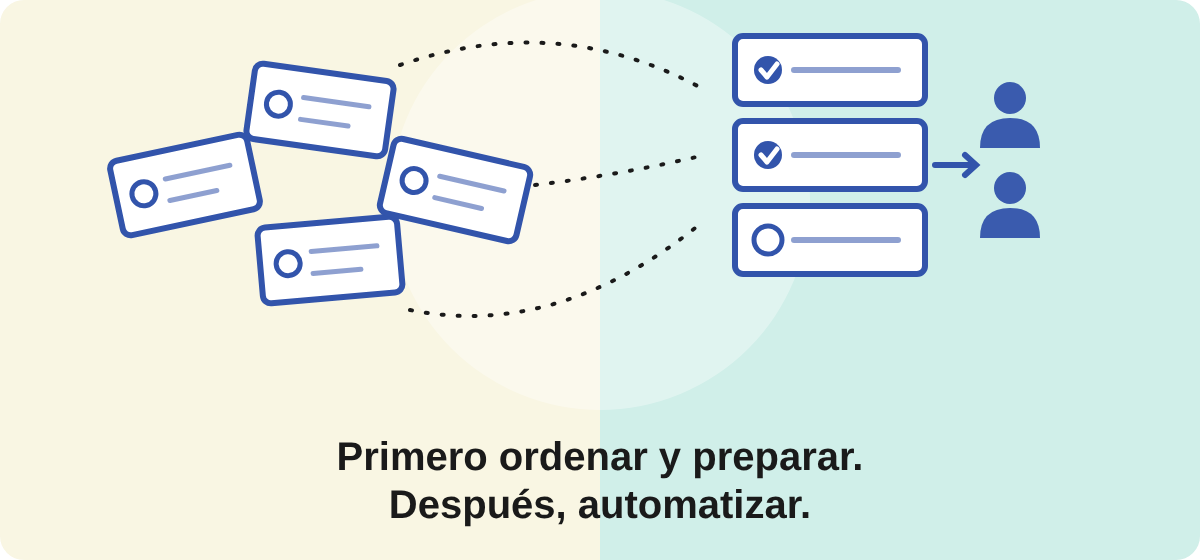
- Organize first, automate later. The report warns that AI amplifies what already exists: if the process is messy, it will make it faster, but still messy.
- Not everything is AI. Sometimes what is needed is a shared board or a tool you already pay for and barely use. If you are evaluating a new one, ask for a couple of demos and compare its cost with the hours the task consumes today.
What we see at Método
These ideas echo what we share on LinkedIn:
- Jose proposes three steps for thinking about what we use the time AI frees up for: efficiency (freeing up time, which is only the first step), productivity (that what you deliver improves in quality and timing) and growth (who you deliver something to and what new value you bring them). Read it on LinkedIn.
- Tatiana tells the case of a company that received an alert about a team with a lot of stress and overtime. We combined a digital log of daily activities, conversations with each team member and scenario simulations, and found that the team was operating at 128% of its capacity, although the overload did not hit everyone equally. Read it on LinkedIn.
Get ideas like this every three weeks
We only need your name and email. No spam: one edition every three weeks, and you can unsubscribe whenever you want.
Frequently asked questions
Why do technology investments fail in companies?
According to recent studies, a frequent cause is underestimating how day-to-day work changes, and not preparing the people who will use the tool. In the Eagle Hill survey, 51% of executives say recent investments did not deliver the intended results, and only 35% say they took the impact on day-to-day work into account before implementing.
How can I tell whether an improvement really worked?
Measure two things together: one of speed and one of quality. For example, hours saved and errors or rework, or cases resolved per day and customer satisfaction. Review them over about three months.
Should I automate with AI or with another tool?
It depends on the task. AI works well for the repetitive part, such as summarizing, cross-checking information or drafting. But sometimes a tool you already have, well used, solves the same thing. Before deciding, follow a request from start to finish to find the real bottleneck.
Where do I start if the information is scattered?
You do not need to organize everything to start. AWS published a guide that proposes moving forward in stages and checking information quality against five criteria: completeness, consistency, accuracy, relevance and timeliness. A practical way: pick the three sources a major decision depends on most, rate them from 1 to 3 on those criteria and start with the one that has reasonably good information and high impact.
Sources
- Eagle Hill Consulting: recent technology investments failed to achieve intended outcomes
- edX: State of Enterprise Learning 2026
- AWS: announcement of the Reimagine report (the ideas and quotes in this guide come from the full report; translations are ours)
- AWS: guide to building a data foundation for AI
The data corresponds to the date of the edition (October 17, 2026).
Prefer to do it with support?
Our starting point is a diagnosis that looks at strategy, talent and technology together. Let's talk about your company.
Let's talk